
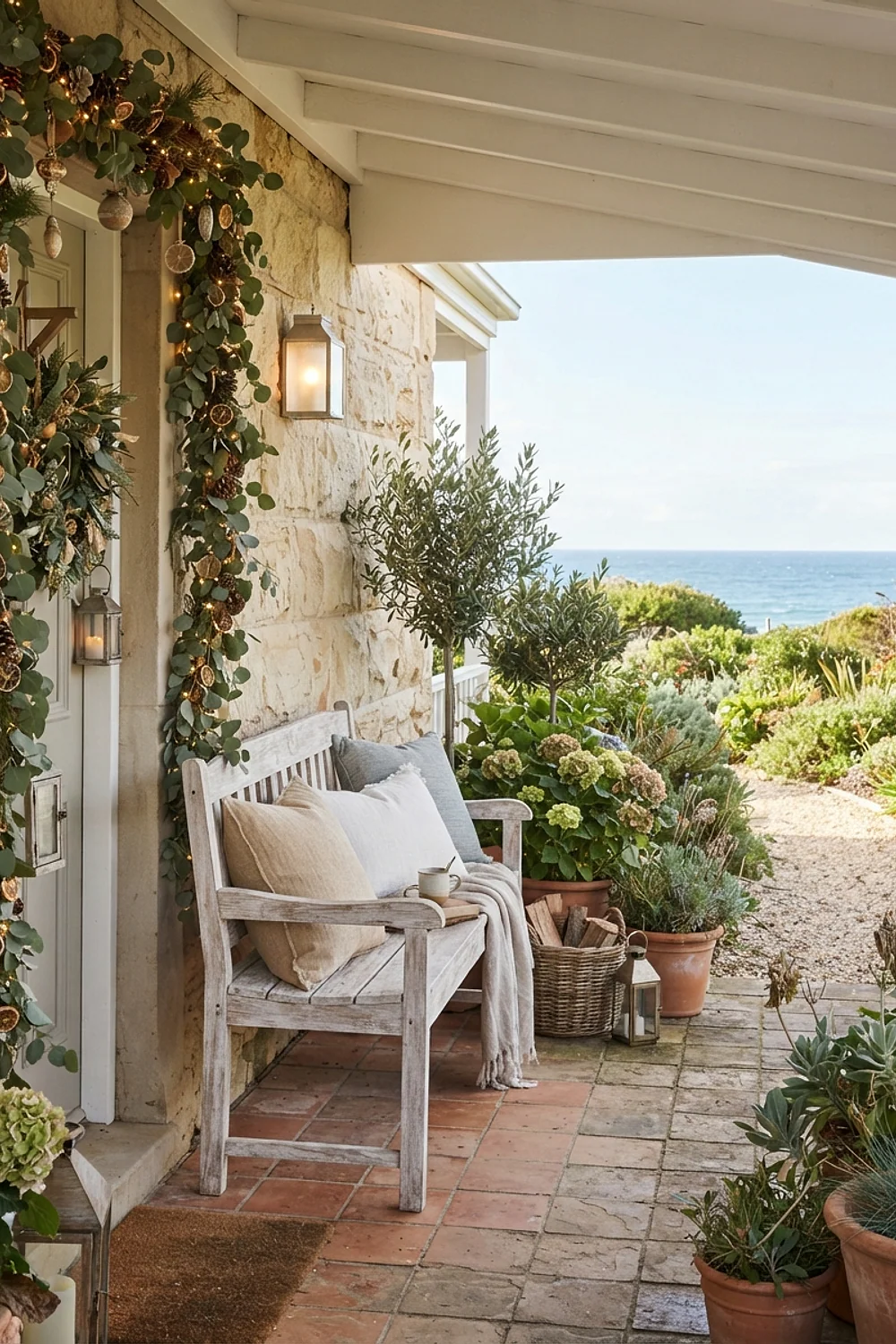
28 Outdoor Christmas Decorations for Every Home Zone
By the end of this list, the porch, the roofline, the backyard and even a 4-foot balcony will each have a clear plan for outdoor christmas decorations that survives wind, rain and a busy household. Every idea is tied to one specific zone, so you can work through the house in the order you walk it.
Think of it as a before and after in 28 small steps. Before: a bare door, a dark walkway, a lawn that disappears at 4:45pm in December. After: layers of light and greenery that read well from the street and still look decent after the first January storm.
Outdoor christmas decorations for every space, from curb to back fence
Start at the street and work inward. Each item below names one zone, explains why the idea works, and flags one thing to avoid.
1. A 24-inch wreath on the front door

A 24-inch wreath is the anchor for the whole exterior, and its color decides whether it reads from the curb. Deep green foliage pops against white, gray or natural wood doors. On a green door it vanishes, so switch to frosted stems or berry-heavy ones.
Door traffic is the stress test here. A door that slams forty times a day during school holidays shakes the needles off fresh noble fir within about two weeks. A wired faux wreath with a rubber-backed hanger holds up better, and a decent pre-lit one runs $60-90. Skip the red bow on a red door, which just blurs.
2. Matching spruce pots flanking the steps

A pair of potted spruces should stand at least 36 inches tall if the door is the standard 80 inches. Anything shorter looks lost against the facade. Wide stoops of 6 feet or more can handle 40-inch trees.
These suit homes with a formal, symmetrical front. Keep 36 inches of clear tread width for walking, because pots that crowd the steps become a trip hazard the first time someone carries groceries up in the dark.
3. Garland spiraled around porch columns

Outdoor christmas decorations look best on a porch when the garland follows the architecture instead of fighting it. A 9-foot garland wraps an 8-foot column in about three loose turns. Tuck in dried orange slices and cedar picks every 12 inches for texture.
Use green floral wire, not zip ties, so the fasteners disappear into the greenery. Pull the spiral loose rather than tight. A tight wrap looks like a barber pole, and it suits Craftsman and colonial columns far better than skinny metal posts.
4. Roofline lights hung with clips

The most common roofline mistake is mixing bulb temperatures. Warm white at 2700K beside cool white at 5000K looks patchy from the street, especially when replacements get bought one box at a time. Pick one temperature and buy all strands together.
Measure the eaves and add 10%. Gutter clips spaced every 12 inches beat staples, which nick the cord insulation. A 25-foot LED C9 strand costs $20-30, and the whole front of a ranch usually needs two or three.
5. A porch bench dressed for waiting guests
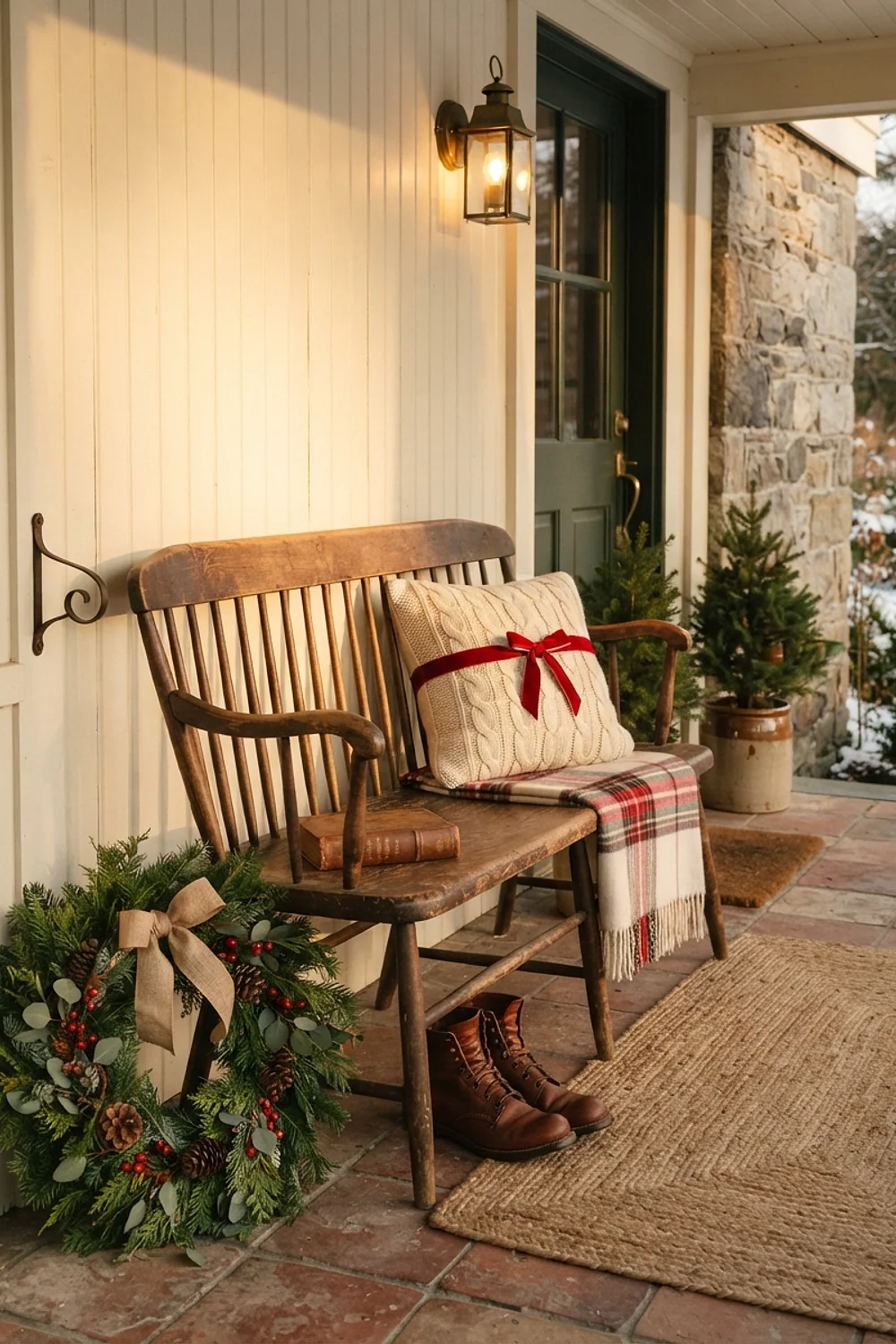
A bench with a seat height of 18 inches and 14-16 inches of depth is comfortable enough for pulling on boots or waiting for a ride. Add a faux sheepskin and a water-resistant cushion in olefin fabric. The soft layers tell visitors someone actually sits here.
This works only on a covered porch at least 5 feet deep. Real wool stays damp in drizzle and starts to smell within a few days, so keep it indoors.
6. Staggered lanterns along the front walk

Walkway lights look best zigzagged, one lantern every 6 feet, alternating sides of a path that’s 36-48 inches wide. Lined up in matching pairs, they turn the path into a runway. Staggering gives even light with half the fixtures.
Set each 12 inches in from the edge. Here’s a counterintuitive catch: solar stakes in northern states often get only 3-4 hours of useful charge in December. For paths over 20 feet, low-voltage or plug-in strings are more reliable.
7. A cedar swag on the mailbox
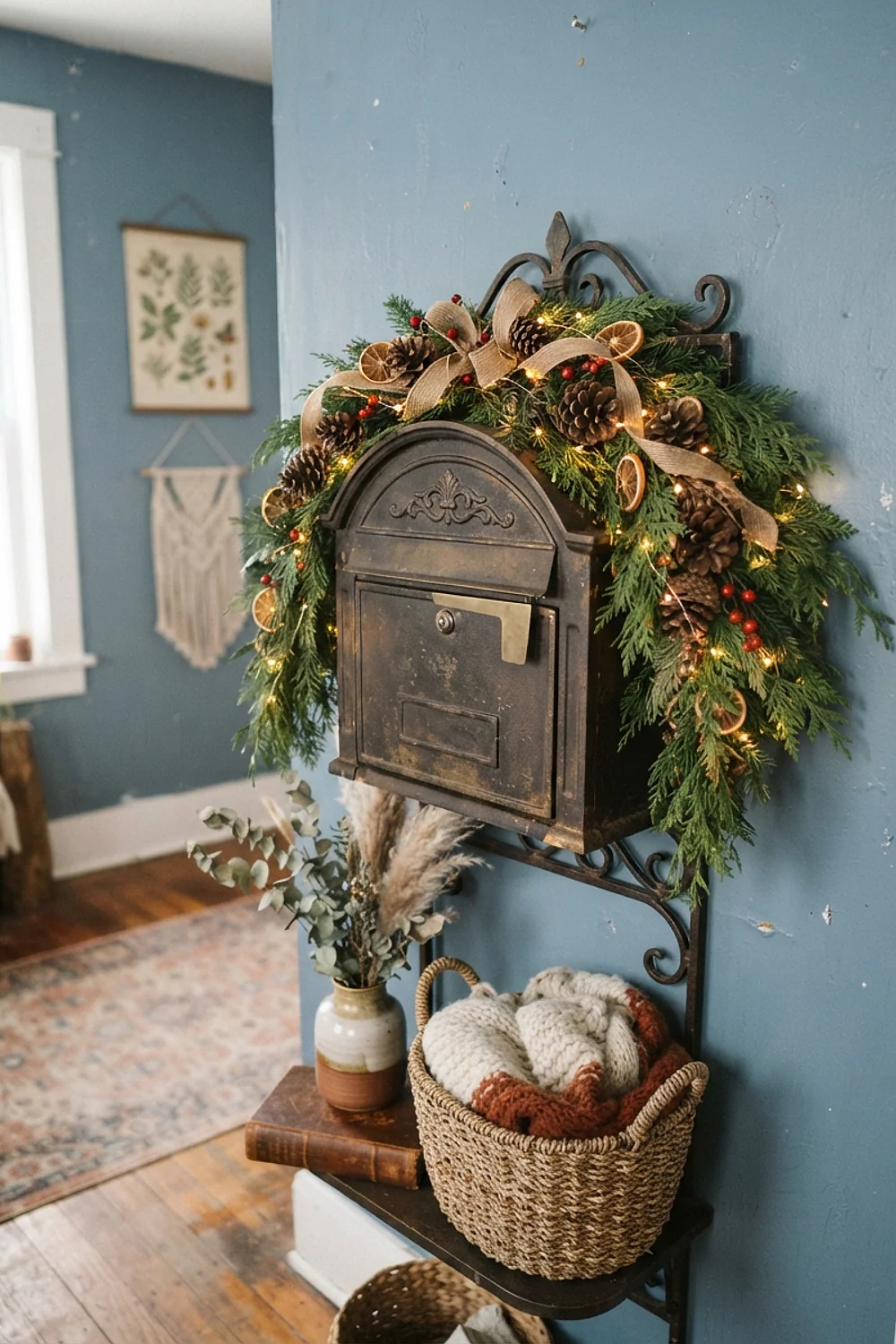
A 12-16 inch swag of cedar and pine, wired to the box with galvanized wire, handles weather well. Use wired outdoor polyester ribbon. Satin streaks and sags on a drizzly Sunday in early December, and the color runs onto the paint.
This fits rural curbside boxes and post-mounted ones alike. Keep the door clear so the carrier can still open it without wrestling greenery, or deliveries stop sticking.
8. Electric candles in the front windows

At 4pm in December, low sun turns glass into a mirror, so candles only show after dusk. Choose 7-inch tapered flameless candles at 2700K and set them on a timer. Hang them at the same height across every window of the facade.
Mixed heights look random from the street, so measure once and mark with painter’s tape. Battery candles without timers drain in about a week, and a dark window among lit ones reads as a mistake.
9. Magnetic wreaths on the garage door

A 16-foot double garage door looks blank during the holidays. Hang three 18-inch wreaths in the centers of the panels, never across the seams, so the door still folds on its track. Magnetic hooks, about $15 for a four-pack, hold up on steel doors.
Aluminum and wood doors won’t hold a magnet, so those need adhesive-backed outdoor hooks. Keep the bottom 6 inches clear of the safety sensors, or the door will refuse to close.
10. A deck box that doubles as seating and storage

A 60-gallon resin deck box, roughly 22 by 48 inches, holds spare light strands and cords while giving the porch a seat. It suits small houses without garage space to spare. Drainage holes matter, because trapped water breeds mildew.
The common mistake is stuffing cords in loose. Wind each strand around a flat piece of cardboard and label it by zone. That way the box becomes a swap-out station rather than a tangle.
11. A wrapped front yard tree in one color

One warm white beats multicolor on a front yard tree, because multicolor bulbs compete with evergreen foliage and look busy from the road. Wrap the trunk up to about 6 feet with roughly 300 mini LEDs, with the strands spaced 3 inches apart.
This is best for bare deciduous trees, which look stark at dusk. Wrap loosely and take the lights down by January, since a tight cord can cut into a growing trunk.
12. One oversized figure on the lawn

A single 6-foot inflatable fits a frontage of 40 feet. Three of them look like a yard sale. Pick one large element and let everything else stay small and quiet.
Secure it with four stakes and sandbags, because the fan runs all night and the wind finds weak anchors. This is best for deep front lawns. Deflate it when gusts pass 15 mph or it will tear on the first fence post.
13. Lanterns beside the door sidelights

Slim 8-inch lanterns with flameless candles suit the narrow glass beside a front door. Hang them in pairs at 60 inches, eye level, with a sprig of eucalyptus tucked behind each. About $25 apiece is a fair price for ones with real metal frames.
Overfilling is the trap. One candle and one sprig per lantern is plenty, and it matters most on homes with a formal entry where the sidelights are already a feature.
14. Driveway edges marked, not decorated

Keep decorations 2 feet outside the paved edge of a driveway. Delivery trucks need roughly 10-12 feet of clearance to turn, and a lit figure in the tire path gets flattened by the second package run.
Snow-country households should use 3-foot reflective stakes with flags so the plow driver sees the boundary. The mistake is lighting the driveway like a landing strip. Marking the edges is enough.
15. Back deck railing with a throw basket

A 36-42 inch railing carries an 8-inch-wide garland comfortably, with battery lights threaded through. A deck at 40°F feels livable when there’s a heat source and a lidded basket of fleece throws within arm’s reach.
This suits families that actually use the deck in winter. Fasten garland with soft ties, since zip ties pinch and snap in the cold. And keep it off the rail where kids lean.
16. A low centerpiece on the patio table

A 48-inch round table needs a centerpiece under 12 inches tall so people can see across it. Run a 12-inch-wide cedar runner with 10-inch hurricane lanterns. Chairs need 36 inches of clearance when pulled out.
Use LED candles. Real flames die in any breeze, and weighted bases keep the lanterns from tipping. This is the setup for outdoor holiday dinners, and it loses its point if guests have to lean sideways to talk.
17. Natural materials around the fire pit

Stacked split logs, wool blankets and copper buckets of pinecones suit a fire pit zone. Keep anything flammable at least 10 feet from the flame. A dry Christmas tree ignites faster than a fresh one, which surprises most people.
Skip plastic garland and dried greenery near the pit entirely. Steel and stone survive sparks, so put the decorative weight there and keep the soft stuff on the seating side.
18. String lights across the pergola

On a 10 by 12 pergola, run three zigzag rows of string lights with a 12-inch drop between beams. Commercial-grade S14 bulbs at 2200K are shatterproof and glow amber. A 48-foot strand costs $45-60, and one pergola needs two.
Cheap thin-wire strands sag after a couple of cold snaps. Pull them taut and secure them with cup hooks every 24 inches, and they’ll hold through January.
19. A timer at the outdoor outlet

Organizing the outlet zone first keeps outdoor christmas decorations running smoothly all season, since every strand depends on that one power source. Use a GFCI outlet with an in-use cover, an outdoor-rated 14-gauge extension cord, and a timer set for 4:30pm to 11pm.
Check the label before chaining strands. Most LED strings allow 20-40 sets end to end, while old incandescent strings allow only three. A smart plug with a sunset schedule saves the hassle of resetting after every power blip.
20. Labeled totes in the garden shed

Store the decorations in 27-gallon totes, one per zone, labeled “porch,” “roofline,” “backyard.” Wind lights on a 12-inch cord reel. Set the totes on pallets 4 inches off the floor, since sheds sweat and cardboard soaks it up.
A 20-inch wreath on the shed door finishes the zone. This pays off for anyone who has spent January untangling one giant knot.
21. A two-color balcony

A 4 by 10 foot balcony is seen from below, so color choices matter. Limit the palette to two, such as white and silver, with a 6 by 3 foot LED curtain light behind the rail.
Check the lease or HOA rules first, because many ban open flame and some limit rail attachments. Tension-mounted pole lights avoid drilling and suit rentals best.
22. Fence wreaths spaced by panel

Each 8-foot panel on a 6-foot privacy fence gets one 18-inch wreath, hung at about 60 inches. Small wreaths read as dots. At $12-18 each, buying in matching sets keeps the repeating rhythm clean.
Attach each to a cross rail with cable ties so wind can’t rattle it loose. This is for long side-yard fences that look bare from the neighbor’s window.
23. A clustered garland on the garden gate

An arbor over a gate, about 7 feet tall and 4 feet wide, looks better with asymmetry. Place three clusters of cedar and berries at one post, plus a lantern at the base, rather than wrapping every inch.
Leave swing clearance. A thick wrap on the latch side jams the gate, and a jammed gate means someone tears the garland off in a hurry.
24. Cut boughs in empty garden beds

Cut spruce, red-twig dogwood and holly pushed into the soil about 6 inches deep make a dormant bed look planted. The stems stay upright because the soil grips them, and the red twigs, dark green needles and berries supply the color that bare mulch lacks. Below 40°F the cold keeps the cut stems fresh, so they hold color for roughly three weeks.
This fits any bed gone dormant. Skip plastic poinsettias, the common mistake, since they crack and fade in frost. Keep the boughs clear of the birdbath edge so birds can still land.
25. A porch swing set for real use

A 6-foot swing hangs 17-19 inches off the floor and needs 3 feet of clearance front and back. Add 4-inch cushions and a plaid blanket in outdoor acrylic. Chains should be rated for 500 pounds or more.
This suits households where the swing already gets used. Keep decor off the seat itself, because a swing buried in greenery stops being a swing.
26. Strip lights tucked under back-step nosings

Light the back steps from below. A 16-foot LED strip tucked under the stair nosing washes each tread with glow, and costs about $20-35 for a four-step flight. It makes the edge visible without a glaring fixture.
Adhesive fails below 40°F, so add clips as backup. Keep 36 inches clear for walking. This matters most for kitchen doors where people step out at night with arms full.
27. A cedar and magnolia window box

A 36-inch window box packed with cedar, pine and magnolia leaves holds for 4-6 weeks in cold weather. The waxy, leathery magnolia leaves turn bronze rather than brown, so the box ages gracefully instead of looking dead. Push stems into the existing soil, which anchors them and keeps cut ends damp.
This is a good fit for houses with wide sills and little yard, where the box is the main display. South-facing boxes dry out fastest, so mist them or choose sturdier boughs there, since soft cedar tips crisp quickly in winter sun.
28. A wrapped lamp post at the curb

An 8-foot lamp post takes about 36 inches of garland at the top and a red ribbon at eye level. Swap the bulb for an LED at 2700K so it matches the roofline. Of all outdoor christmas decorations, this one is seen first.
Check the wattage on the fixture before swapping bulbs, since over-lamping cooks the socket. It suits corner lots and long driveways where the post marks the entrance.
Things that elevate the room
Outdoor christmas decorations go wrong in the planning stage far more often than in the buying stage. A tape measure and ten minutes before shopping prevent most returns.
- Measure eaves and add 10% for corners and drops.
- Allow one oversized element per 20 feet of frontage.
- Keep 36 inches clear on paths and steps.
- Space clips or hooks every 12 inches along the roofline.
- Hang wreaths at 60 inches, roughly eye level.
Skip the staples.
Cord management matters too. Run cords along the edge of surfaces, never across the walkway, and tape connections inside a weatherproof cover to keep out sleet.
Making outdoor christmas decorations flow between rooms and zones
Pick two materials and repeat them from the front gate to the back fence. Cedar and galvanized metal work well, for example. When the same elements show up on the porch, the pergola and the shed, the exterior reads as one design instead of a pile of purchases.
Look, the view from inside counts as well. The living room window frames the porch, and the kitchen window frames the deck. Check each from indoors at dusk, because one dark gap in that view ruins the effect.
- Choose one bulb temperature, 2700K, for every zone.
- Repeat a ribbon color at least three times, at the door, the mailbox and the gate.
- Light the transitions, steps and gates, so movement feels guided.
Bringing your outdoor christmas decorations together
Start with the front door and the roofline, then add one zone per weekend. Outdoor christmas decorations built in layers survive weather better and cost less than a single big haul. Save or pin this list so it’s handy when the boxes come out, and measure your eaves before buying a single strand.
Frequently Asked Questions
When should outdoor christmas decorations go up?
Most households start the weekend after Thanksgiving, when temperatures are still above 40°F and adhesive and clips hold well. Putting them up in early November works if lights are on a timer. Just avoid fresh greenery that early, since it dries out before December ends.
How many lights do I need for a one-story house?
A typical ranch with 60 feet of eaves needs about 66 feet of string lights, which is 60 plus 10%. That’s usually three 25-foot C9 strands. Add more only if there are gables or dormers.
Are outdoor christmas decorations safe in rain and snow?
Yes, if they’re rated for outdoor use and plugged into a GFCI outlet with an in-use cover. Look for the UL outdoor listing on the box. Keep plug connections off the ground and inside a weatherproof cover.
How do I hang outdoor christmas decorations in a rental?
Use gutter clips, tension poles, over-the-door hangers and weighted pots, none of which need drilling. Magnetic hooks work on steel doors. Check the lease for rules on rail attachments and open flame before buying.